

12 September 2026
PowerBuilding a Household Blackout Box: Practical Resilience for Everyday Life
Learn how to build a practical blackout box with lighting, power banks, first aid, emergency contacts, and essential supplies for any household.
Modern life is incredibly convenient, but it's also heavily dependent on systems that most of us have very little control over. Electricity powers our homes, phones store our contacts, card machines handle our spending, and internet connections support everything from communication to banking.
Most of the time, these systems work flawlessly. Occasionally, however, a storm brings down power lines, a local outage interrupts communications, or a piece of infrastructure fails when it's least expected.
That's why every household can benefit from a simple blackout box.
This isn't about preparing for extreme scenarios. It is about having a collection of practical items ready to make an unexpected disruption easier to manage. A well-stocked blackout box can reduce stress, improve comfort, and help you support both your household and others around you when normal services are temporarily unavailable.
Why Household Resilience Matters
We are becoming more reliant on electricity and technology with every passing year. Heating systems, internet services, mobile phones, online banking, navigation, entertainment, our cars; even grocery shopping often depend on reliable power and communications networks.
At the same time, extreme weather events seem to be becoming more common, infrastructure is ageing, and local disruptions remain a fact of life.
Most outages are short-lived and relatively minor. A few hours without power is hardly the end of the world. However, having some basic preparations in place can make those few hours significantly less stressful.
More importantly, a household that can comfortably manage a temporary disruption is better positioned to help neighbours, friends, and family who may be struggling.
What Is a Blackout Box?
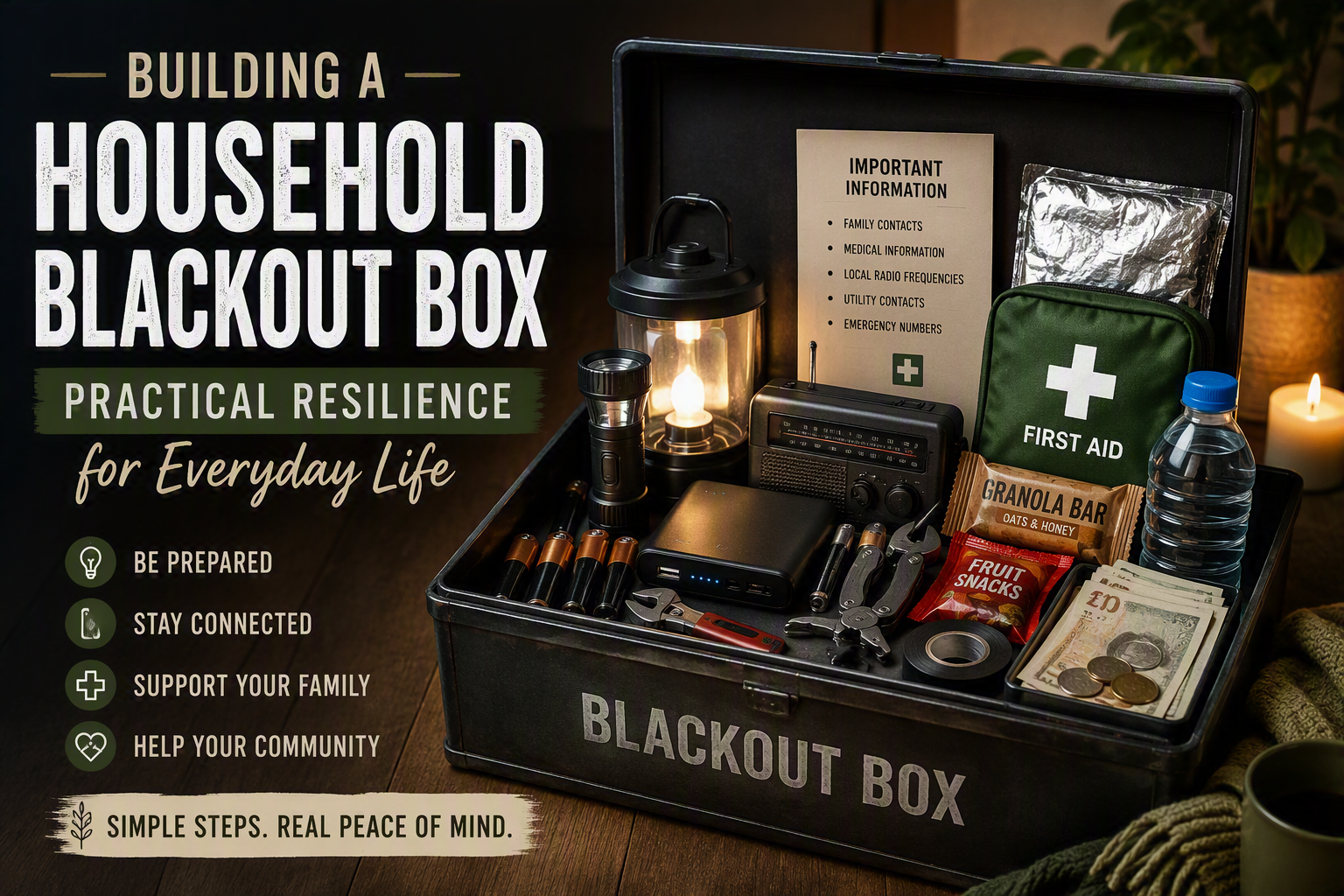
A blackout box is simply a container that keeps essential emergency supplies together in one easily accessible place.
The concept is remarkably simple:
If the lights go out, everyone knows exactly where to find the items they need.
Our blackout box lives under the stairs and is made of an old, repurposed filing cabinet that was heading for disposal; proving that you don't need specialist equipment to get started.
What matters is the contents, not the container.
Lighting Comes First
When the power goes off unexpectedly, light becomes the immediate priority.
A good blackout box should contain several types of lighting rather than relying on a single solution.
Recommended options include:
- Rechargeable torches
- A battery-powered torch
- Spare batteries
- A wind-up lantern
- Candles and a lighter as a backup
Having multiple lighting options creates redundancy. If rechargeable devices run flat or batteries fail, there is always another way to illuminate a room safely.
A lantern can be especially useful because it illuminates an entire area rather than producing a narrow beam like a torch.
Communication and Information
During a prolonged outage, access to information can be almost as important as access to light.
A battery-powered or wind-up radio provides an alternative source of information if internet services or mobile networks become unavailable.
Alongside the radio, power banks should form a key part of any blackout box.
Quality power banks help preserve the ability to:
- Make phone calls
- Send messages
- Access emergency information
- Stay in contact with family
Rather than relying on a single small charger, it makes sense to keep several good-quality power banks charged and ready.
A small foldable solar panel can add another layer of resilience by providing a way to recharge devices during longer outages without depending on mains electricity.
Don't Forget the Simple Things
The most useful items are often the least glamorous.
A small supply of bottled water and long-life snacks can provide comfort during an extended disruption. They can also prove invaluable if a visitor, neighbour, or stranded motorist needs assistance.
Items worth including include:
- Bottled water
- Breakfast bars
- Energy snacks
- A few comfort treats
- Pet treats if you have animals
Emergencies can be stressful, and familiar food and drink can make a surprising difference to morale.
First Aid and Practical Tools
A basic first aid kit deserves a permanent place in any blackout box.
It should contain supplies suitable for treating minor injuries while waiting for professional help if required.
Equally useful is a small toolkit.
A basic toolkit doesn't need to be extensive. Consider including:
- Screwdriver with interchangeable bits
- Adjustable spanner
- Pliers
- Electrical tape
- Cable ties
- Utility knife
- Small torch
Many problems encountered during emergencies are surprisingly mundane, and having a few tools immediately available can save time and frustration.
Warmth and Comfort
Power cuts during winter introduce a different challenge: staying warm.
A compact thermal blanket takes up almost no space yet can provide valuable additional warmth if heating is unavailable.
Thermal blankets are inexpensive, lightweight, and easy to store, making them one of the easiest additions to any resilience kit.
Candles can also help make a room feel more comfortable. While they should never be considered a heating solution, they provide light, a small amount of warmth, and perhaps most importantly, a sense of calm.
Entertainment Still Matters
One item often overlooked in emergency planning is entertainment.
Sitting in the dark waiting for power to return can quickly become tedious and stressful.
Low-tech entertainment helps pass the time and maintains a sense of normality.
Good options include:
- Playing cards
- Board games
- Dice games
- Children's activity books
- Puzzle books
A family gathered around a card game will generally cope better than one sitting silently watching dwindling phone batteries.
Keep Some Cash Available
Most purchases today are completed using cards or mobile payment systems.
Unfortunately, those systems depend on electricity and communication networks.
Keeping a small amount of cash in useful denominations can prove valuable if card terminals are unavailable during a local outage.
This doesn't mean storing large sums of money at home.
A modest amount intended for essential purchases is usually sufficient.
The Most Important Addition: Information
One of the most valuable items in any blackout box isn't a gadget at all.
It's information.
A printed sheet should include:
- Important family contact numbers
- Relevant medical information
- Local radio frequencies
- Utility company contact details
- Emergency numbers
- A basic action checklist
Most of us no longer remember important phone numbers because our phones do the remembering for us. If batteries fail or mobile devices become unavailable, having key information written down can be invaluable.
Review and update the sheet periodically to ensure information remains accurate.
Start Small
One of the biggest mistakes people make is assuming that preparedness has to be expensive.
It doesn't.
Most households already own at least some of the essentials:
- A torch
- Spare batteries
- A power bank
- A first aid kit
- Playing cards
- Bottled water
Bring those items together in a clearly labelled box and you've already made a significant improvement.
You can add further items gradually as time and budget allow.
Preparedness doesn't need to be perfect.
It just needs to be better than having nothing at all.
Final Thoughts
Household resilience isn't about expecting disaster. It's about recognising that service interruptions, power cuts, storms, and unexpected disruptions occasionally occur.
A blackout box won't prevent those events from happening.
What it will do is help you respond calmly and confidently when they do.
With a torch, a radio, some power, basic supplies, important information, and a few creature comforts close at hand, an unexpected outage becomes far easier to manage.
Sometimes the most effective preparations are also the simplest.
A single box under the stairs may never become the most exciting possession in your home, but when the lights suddenly go out, it could be one of the most useful.