
17 October 2026
FoodCooking Without Electricity UK: A Practical Emergency Cooking Strategy
Learn how to cook without electricity in the UK during a power cut. Discover safe emergency cooking methods, essential equipment, fuel storage and practical no-cook meal ideas.
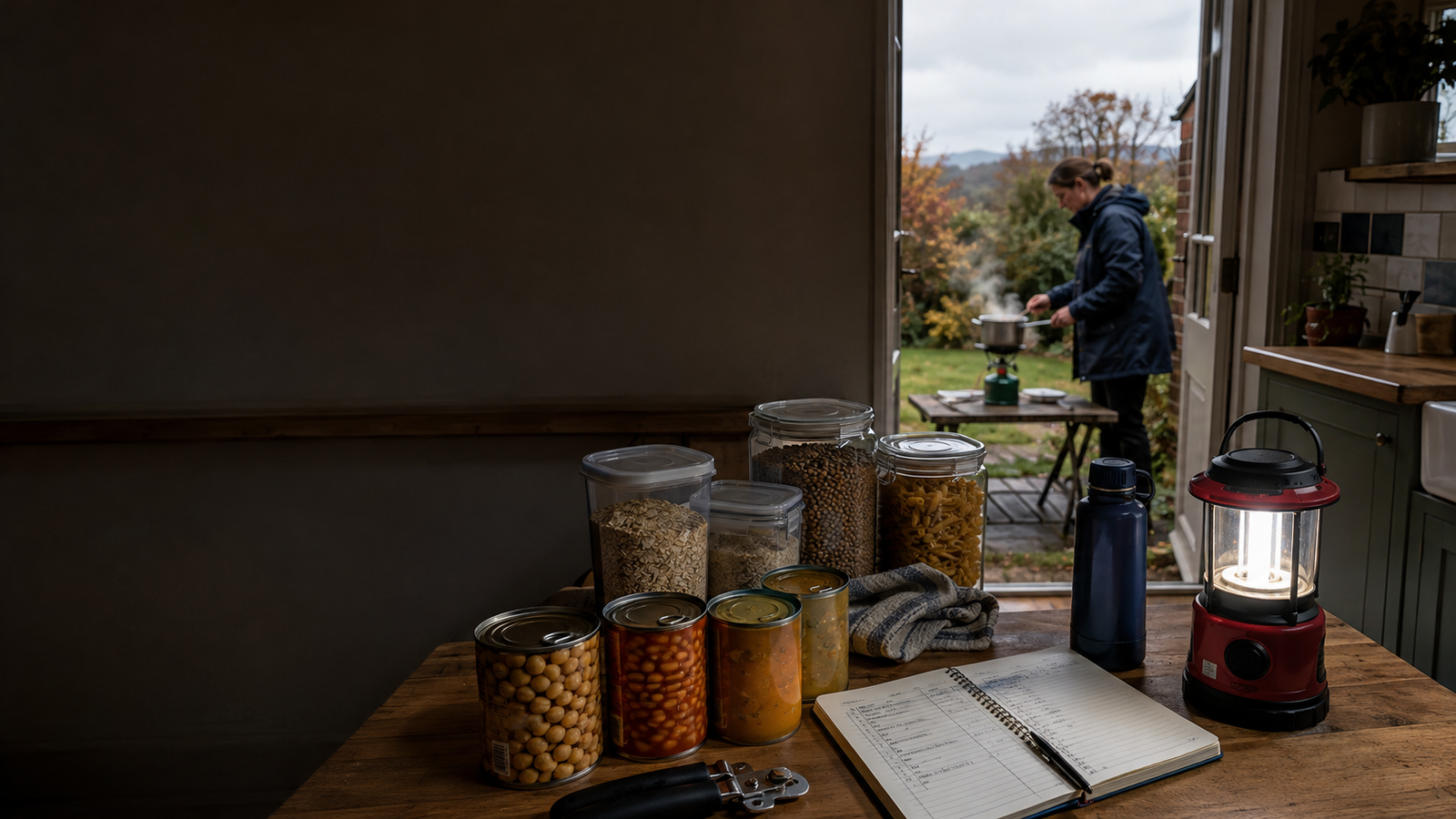
Imagine it is a cold November evening. The wind is rattling the windows, the lights have gone out, and your electric hob is little more than a useless piece of glass. You have food in the cupboards, but how are you going to prepare a hot meal?
For many households, cooking without electricity is something they rarely consider until they have to do it. Yet a power cut can affect far more than lighting and entertainment. It can disrupt cooking, hot drinks, food storage and, in some circumstances, access to clean water.
The good news is that you do not need an expensive off-grid kitchen or a garden full of specialist equipment to become better prepared.
With a little planning, some sensible food choices and a safe alternative cooking method, most households can make a power cut considerably more manageable.
This guide explains how to develop a practical cooking without electricity strategy for UK households, covering emergency cooking equipment, fuel, food storage, meal planning and the safety considerations that should come first.
Why prepare for cooking without electricity?
Power cuts in the UK are generally localised and often relatively short. However, severe weather, damaged infrastructure and wider supply disruptions can occasionally cause longer outages.
Even a relatively brief interruption can become inconvenient if your household relies entirely on an electric cooker, kettle and microwave.
Consider a typical evening meal. You might need electricity to boil water, cook rice, heat vegetables and prepare a sauce. Remove that supply and an ordinary dinner suddenly becomes much more complicated.
Preparation is about removing that dependence.
A good strategy should allow you to:
-
Prepare meals and hot drinks without mains electricity.
-
Feed your household for at least 72 hours, with a longer-term plan where practical.
-
Avoid unnecessary waste when refrigerated and frozen food is at risk.
-
Keep fuel use economical and controlled.
-
Cook safely without introducing fire or carbon monoxide hazards.
-
Continue eating reasonably varied meals rather than relying entirely on snacks.
The objective is not to recreate your normal kitchen. It is to establish a simple, reliable system that works when your usual facilities are unavailable.
1. Start with the simplest solution: food that needs no cooking
Before spending money on camping stoves or alternative fuels, look at what you can eat without heating anything.
This is an important distinction. Your emergency food supply should not depend entirely on your ability to cook.
A stove can fail, fuel can run out, or bad weather may make outdoor cooking impractical. Having food that can be eaten straight from the packet gives you a useful backup.
Good options include:
-
Tinned beans, chickpeas and lentils.
-
Tinned vegetables, fruit and soup that can be eaten cold if necessary.
-
Crackers, oatcakes and crispbreads.
-
Peanut butter and other nut or seed spreads.
-
Dried fruit and nuts.
-
Breakfast cereals and muesli.
-
UHT milk and plant-based alternatives that do not require refrigeration before opening.
-
Ready-to-eat meals and suitable shelf-stable pouches.
-
Protein bars and other compact snacks.
A manual tin opener is essential if you keep canned food. It is a small item, but an electric opener is of little use when the power is off.
Think about the people you are feeding, too. Children, older relatives and anyone with specific dietary requirements may need different foods. Pets should also have their own emergency supplies.
The first rule of emergency cooking is that you should still be able to eat if you cannot cook at all.
2. Choose an emergency cooking method
Once you have a no-cook food supply, consider how you will prepare hot meals.
There is no single best option for every household. Your choice will depend on your property, available outdoor space, budget, storage arrangements and how long you expect to be without electricity.
Option A: A camping stove
For many households, a portable camping stove is the most practical emergency cooking appliance.
Compact models can boil water and prepare simple meals using compatible fuel canisters. Larger camping stoves may offer multiple burners, although they require more storage space and fuel.
A stove can be useful for boiling water for porridge, preparing instant meals or heating a simple one-pot dinner.
Before buying one, check:
-
Which fuel it uses and whether that fuel is readily available.
-
Whether the stove is intended for outdoor use only.
-
The manufacturer's instructions and compatible cookware.
-
How stable the stove is when supporting a saucepan.
-
Whether you can store the appliance and its fuel safely.
-
How long the fuel is expected to last under realistic conditions.
For most portable camping stoves, outdoor use is the only safe option. Do not bring one into your kitchen, garage, shed, caravan or tent to cook, even if you open a window or leave a door ajar.
Combustion can produce carbon monoxide, an odourless, potentially fatal gas.
A camping stove is useful equipment, but it must never become a reason to take unnecessary risks.
Option B: A barbecue
A barbecue can be useful if you already own one and have a suitable outdoor area.
Charcoal and gas barbecues can prepare a range of foods, including vegetables, baked potatoes and simple one-pot meals when the appliance is designed to accommodate them.
However, there are limitations.
Charcoal can take time to light and reach cooking temperature. Gas barbecues depend on an adequate supply of the correct fuel. Wind and rain can also make outdoor cooking more difficult.
There is an absolute safety rule here: never use a barbecue indoors, in a tent, in a garage or in another enclosed or poorly ventilated space. This applies to disposable barbecues as well as larger models.
A barbecue should be treated as an outdoor cooking option, not an emergency indoor heater.
Option C: A wood-burning stove or solid-fuel range
Some homes already have a properly installed wood-burning stove or traditional solid-fuel range. Depending on its design, it may offer a useful cooking facility during a power cut.
This can be particularly helpful in a rural property where such an appliance is already part of everyday life.
However, a wood burner is not automatically a cooking appliance. Only cook on one if the manufacturer confirms that it is designed for that purpose, and follow the operating and ventilation instructions.
Never improvise by burning household rubbish, treated timber or unsuitable materials.
Installing a stove purely for emergency cooking may be an expensive and impractical solution for many households. It is better considered part of a wider heating and resilience plan.
Option D: A thermal cooker or insulated cooking system
A thermal cooker uses an insulated container to retain heat after food has been brought to the required temperature using a separate heat source.
It does not generate heat itself. You still need a safe way to heat the ingredients initially.
Its advantage is that it can reduce the amount of time a hob or stove needs to operate. This can make a limited supply of fuel go further.
Some people also use insulated cooking bags or similar products, but you should follow the manufacturer's guidance on safe temperatures, cooking times and suitable foods.
Do not assume that insulation alone makes food safe. Ingredients must reach an appropriate cooking temperature, and food must be kept out of the temperature range where harmful bacteria can multiply.
3. Build a simple emergency cooking kit
You do not need to buy everything at once. Start with the essentials and add equipment as your budget allows.
A practical kit might contain:
-
A suitable outdoor camping stove.
-
The correct compatible fuel, stored according to the manufacturer's instructions.
-
One or two lightweight saucepans with lids.
-
A kettle suitable for your chosen cooking appliance, if needed.
-
A manual tin opener.
-
A long-handled spoon and basic utensils.
-
A heat-resistant mat or other suitable surface, where appropriate.
-
Matches or a lighter, stored safely and kept dry.
-
A head torch or battery-powered lantern.
-
A supply of drinking water.
-
Hand sanitiser, cleaning wipes and rubbish bags.
-
A food thermometer for checking cooked food where appropriate.
You may already own much of this equipment.
If you have children or pets, think carefully about where you will set up the cooking area. A stable, level outdoor surface away from doorways, dry vegetation and anything combustible is preferable.
Keep the equipment together in a labelled container so that you are not searching through cupboards in the dark.
It is also worth trying everything before an emergency occurs. Read the instructions, check the equipment and learn how to assemble and operate it correctly.
Do not wait until a storm has knocked out the electricity to discover that your fuel canister is empty or your stove is incompatible with the cookware you own.
4. Choose food that uses less fuel
One of the most effective ways to improve your emergency cooking strategy is to choose meals that require less energy to prepare.
During a prolonged power cut, fuel efficiency matters. Every unnecessary minute spent heating a pan uses resources that may be difficult to replace.
The answer is not complicated cooking. It is simpler cooking.
Build meals around a few basic ingredients
Dried pasta, rice, lentils and oats are useful cupboard staples, but they differ in the amount of water and cooking time they require.
Quick-cooking pasta, instant couscous and porridge oats are particularly convenient because they can be prepared relatively quickly.
Tinned pulses are also valuable. Unlike dried beans, which can require prolonged soaking and cooking, tinned chickpeas, lentils and beans are already cooked and can be eaten without further heating.
That makes them particularly useful when fuel is limited.
Consider keeping a mixture of:
-
Quick-cooking carbohydrates, such as couscous and instant oats.
-
Tinned beans, lentils and chickpeas.
-
Tinned tomatoes and vegetables.
-
Shelf-stable sauces and seasonings.
-
Nuts, seeds and nut butters for additional energy and protein.
-
Ready-to-eat foods that do not require heating.
You can combine these ingredients into filling meals without needing a large collection of pans or an elaborate cooking process.
Use lids and sensible portion sizes
A saucepan lid helps retain heat and can shorten cooking time.
Choose a pan that is appropriate for the quantity of food you are preparing. Heating a large volume of water to cook a small portion of pasta is inefficient.
Follow the stove manufacturer's instructions and avoid using oversized cookware that may interfere with safe burner operation.
Where a thermal cooking system is available, it may help reduce fuel consumption after the food has been heated sufficiently.
The broader principle is simple: plan meals around the fuel you have, rather than assuming fuel will always be available.
5. Example emergency meals
Emergency meals do not have to be miserable. With a small selection of versatile ingredients, you can prepare reasonably varied food even when the electricity is unavailable.
Here are some examples.
Breakfast: Porridge with fruit and nuts
Porridge oats, UHT milk or water, dried fruit and nuts make a straightforward breakfast.
If you have a suitable cooking appliance, prepare only what you need and use a lid to help retain heat. Instant porridge is another option when you have access to hot water.
If heating is impossible, muesli with shelf-stable milk provides an alternative.
Lunch: Chickpea and tomato couscous
Combine couscous with tinned chickpeas, tinned tomatoes and seasoning.
Couscous generally needs only hot water and a short standing time, making it useful when fuel is limited. Check the packet instructions and ensure any additions are handled safely.
The chickpeas provide protein, while the couscous supplies carbohydrates.
If you cannot heat the ingredients, you can use the chickpeas and tomatoes in a cold meal with crackers or oatcakes, provided the products are safe to eat as supplied.
Dinner: One-pot lentil and vegetable stew
Use tinned lentils, tinned vegetables, chopped tomatoes and a stock cube or suitable seasoning.
Combine the ingredients in one pan and heat until the food is steaming hot throughout.
Because the lentils and vegetables are already cooked, the aim is to heat the meal thoroughly rather than cook raw ingredients for a long period.
This is an economical meal that can be adapted to suit different tastes.
An easy no-cook meal
For days when cooking is impossible, combine tinned beans or chickpeas with crackers, nut butter, dried fruit and a suitable ready-to-eat accompaniment.
It may not be your preferred dinner, but it provides a practical fallback.
The key is to have tested these options before you need them. A food supply is far more useful when you know your household will actually eat it.
6. Manage water as carefully as fuel
Cooking without electricity is not just about producing heat.
You also need water for drinking, preparing food, washing hands and cleaning utensils.
A meal that requires several litres of water may be a poor choice if your water supply is disrupted or you have limited stored reserves.
Plan meals that need minimal preparation water, and remember that some water will be needed for hygiene as well.
Keep drinking water in clean, food-grade containers and follow current public-health advice if the mains water supply is affected.
Do not assume that rainwater, water from a garden water butt or water collected outdoors is safe to drink without appropriate treatment.
It is also worth thinking about washing-up. A simple meal prepared in one pan is easier to clean than a complicated dinner involving several pots and utensils.
If water is limited, avoid creating unnecessary washing-up in the first place.
7. Protect your refrigerated and frozen food
When the power goes out, the food in your fridge and freezer may become a concern before you even start cooking.
Resist the temptation to open the fridge repeatedly to see what is inside. Keeping the doors closed helps preserve the cold temperature.
The Food Standards Agency advises that a fridge will generally stay cold for up to four hours, while a full freezer may remain frozen for up to 48 hours and a half-full freezer for around 24 hours. These are estimates, not guarantees, and actual temperatures vary.
A fridge thermometer is useful because it gives you more information than simply guessing how warm the interior feels.
If refrigerated food reaches 8°C or above, the Food Standards Agency advises that food normally requiring refrigeration should be eaten within four hours of reaching that temperature or discarded. Follow official guidance for individual foods and do not rely on smell or appearance to determine whether something is safe.
Think strategically about what you eat first.
Food that needs refrigeration may have a shorter safe storage window than unopened tinned goods and other shelf-stable supplies. Plan meals accordingly, but do not take risks with food that has been held at unsafe temperatures.
For detailed guidance, see the Food Standards Agency's advice on food safety during a power cut.
8. Fuel storage: prepare sensibly, not excessively
It is tempting to buy large quantities of fuel when planning for emergencies. However, safe storage is more important than simply accumulating supplies.
Different fuels have different storage requirements, and some can present serious fire risks if stored incorrectly.
Follow the manufacturer's instructions and the relevant safety guidance for the specific product you own.
In practice:
-
Store fuel only in approved, compatible containers.
-
Keep fuel away from heat sources, ignition sources and direct sunlight where instructed.
-
Never store fuel in living areas or escape routes.
-
Keep canisters and fuel away from children.
-
Do not use damaged or leaking containers.
-
Avoid buying fuel for an appliance you have not tested or learned to operate.
-
Check storage limits and any restrictions that apply to your property.
Do not transfer fuel between containers unless the equipment and manufacturer's instructions specifically allow it.
If you live in a flat or have very limited outdoor storage, your options may differ considerably from those of someone with a detached house and a secure outbuilding. Choose a strategy that fits your actual circumstances.
For many households, keeping a modest quantity of suitable fuel and a larger supply of no-cook food is more practical than trying to store enough fuel to cook every meal for weeks.
9. Carbon monoxide and fire safety: the non-negotiable rules
This is the section I would encourage every reader to take seriously.
Carbon monoxide is an odourless gas that can cause severe illness or death. Fuel-burning equipment can also start fires, particularly when used in cramped spaces or near combustible materials.
A power cut does not make an unsafe cooking method acceptable.
Never use a camping stove, barbecue, charcoal burner or other outdoor fuel-burning appliance inside your home, garage, tent or other enclosed space. Opening windows or doors does not make this safe.
A few essential precautions:
-
Operate equipment only in the locations specified by the manufacturer.
-
Keep cooking appliances stable and away from combustible materials.
-
Never leave a lit stove or barbecue unattended.
-
Keep children and pets away from hot equipment.
-
Allow appliances and fuel to cool or be stored only as directed.
-
Do not bring a smouldering barbecue indoors after cooking.
-
Keep escape routes clear.
-
Maintain appropriate smoke and carbon monoxide alarms in your home.
If you suspect carbon monoxide exposure, get everyone outside into fresh air and seek medical help. Do not re-enter the building until you have received appropriate professional advice. Call 999 for severe symptoms or an emergency.
For further information, consult the NHS guidance on carbon monoxide poisoning and the London Fire Brigade's home cooking safety advice.
If you cannot cook safely, do not cook. Eat food that requires no preparation, or seek an alternative safe location.
10. Build a 72-hour cooking strategy
A useful way to put all this together is to plan for the first three days of a power cut.
The following is an example framework rather than a fixed ration plan. Adjust the quantities to the number of people in your household, their dietary requirements and individual energy needs.
Day one: Use what you already have
Start by checking the fridge and freezer without leaving their doors open for long.
Prepare suitable perishable food first, provided it has remained at safe temperatures. If the electricity returns quickly, you may not need to use much of your emergency equipment.
If you have a safe, approved alternative cooking method, use it for a simple meal.
Day two: Move towards cupboard staples
If the outage continues, begin relying more heavily on shelf-stable foods.
Couscous, oats, tinned beans, lentils, fruit and ready-to-eat meals offer useful flexibility.
Choose meals that use one pan, little water and relatively little fuel.
Keep a written note of the food and fuel you have used so you can see what remains.
Day three: Review your resources
By the third day, you should have a clearer idea of how long the disruption may last.
Review your remaining drinking water, ready-to-eat food, cooking fuel and household needs.
If fuel is becoming scarce, switch to meals that need no heating. Avoid using unsuitable appliances or improvising with dangerous fuels.
Check official updates and consider whether you need to obtain supplies, contact relatives or neighbours, or move to a safer place if your circumstances require it.
A good plan includes a point at which you stop trying to maintain normal routines and adapt to the resources available.
11. Practise before the power goes out
The best emergency equipment is equipment you understand.
Choose a dry day and prepare a simple meal using your intended emergency cooking method in the correct outdoor location.
Time how long it takes to boil water and prepare food. Check how much fuel you use, how easy the equipment is to clean and whether you have everything you need.
Try a meal that uses only one pan. Then try a no-cook meal.
You may discover that the biggest obstacle is not cooking at all, but something more mundane: finding the tin opener, locating the matches or realising that you have no water stored nearby.
These are easy problems to fix before an emergency.
You can also use the exercise to involve the rest of your household. Everyone should know where the food is stored, what can be eaten without cooking and which appliances must never be used indoors.
Preparedness is much more effective when it is familiar rather than theoretical.
12. Keep the strategy affordable
You do not need to spend hundreds of pounds to prepare for cooking without electricity.
Start with a few practical steps:
-
Build a small supply of food that can be eaten without cooking.
-
Buy a manual tin opener if you do not already have one.
-
Store drinking water appropriately.
-
Choose a suitable alternative cooking appliance if you have a safe place to use it.
-
Buy only compatible fuel and follow its storage instructions.
-
Test your plan before relying on it.
Add to your supplies gradually, using foods that you already eat and rotate them as part of your normal shopping.
This avoids building a cupboard full of emergency food that nobody likes and that eventually goes to waste.
A simple, well-practised plan is usually more valuable than an impressive collection of equipment that has never been used.
Final thoughts: make cooking resilience part of your preparedness plan
Cooking without electricity in the UK is not especially difficult once you have thought through the practical details.
The challenge is not finding one magic appliance. It is creating a system that combines shelf-stable food, drinking water, safe cooking equipment, suitable fuel and a clear fallback if heating food becomes impossible.
Start small. Keep a few meals that need no cooking, understand how you would prepare hot food safely, and make sure your household knows what to do.
Most importantly, never let the desire for a hot meal outweigh basic fire and carbon monoxide safety.
A power cut may be inconvenient, but with a little preparation it does not have to leave you without a workable meal plan.
Preparedness is not about expecting the worst. It is about making ordinary problems easier to manage.
Further reading
For more practical preparedness advice, explore these resources on UKPrepper.me:
-
The Five Ds of Perimeter Security: Building a Layered Protection Strategy — a guide to improving your home's security and resilience.
-
UKPrepper.me — explore more guides on emergency planning, household preparedness and practical self-reliance.
Official sources and further guidance
UKPrepper.me — Practical preparedness for everyday people.