12 September 2026
General PreppingPrepping vs Survivalism vs Emergency Preparedness: What's the Difference?
Understand the difference between emergency preparedness, prepping, and survivalism. A practical guide to building resilience for UK households facing unexpected disruptions.
Spend enough time in preparedness circles and you'll hear the terms prepping, survivalism, and emergency preparedness used almost interchangeably. To many people, they all conjure the same image: shelves full of canned food, backup generators, and plans for when things go wrong.
The reality is a little more nuanced.
While all three approaches share a common goal of being ready for unexpected events, they differ significantly in both mindset and scope. Understanding these differences can help people decide where they sit on the preparedness spectrum and what level of readiness makes sense for their own circumstances.
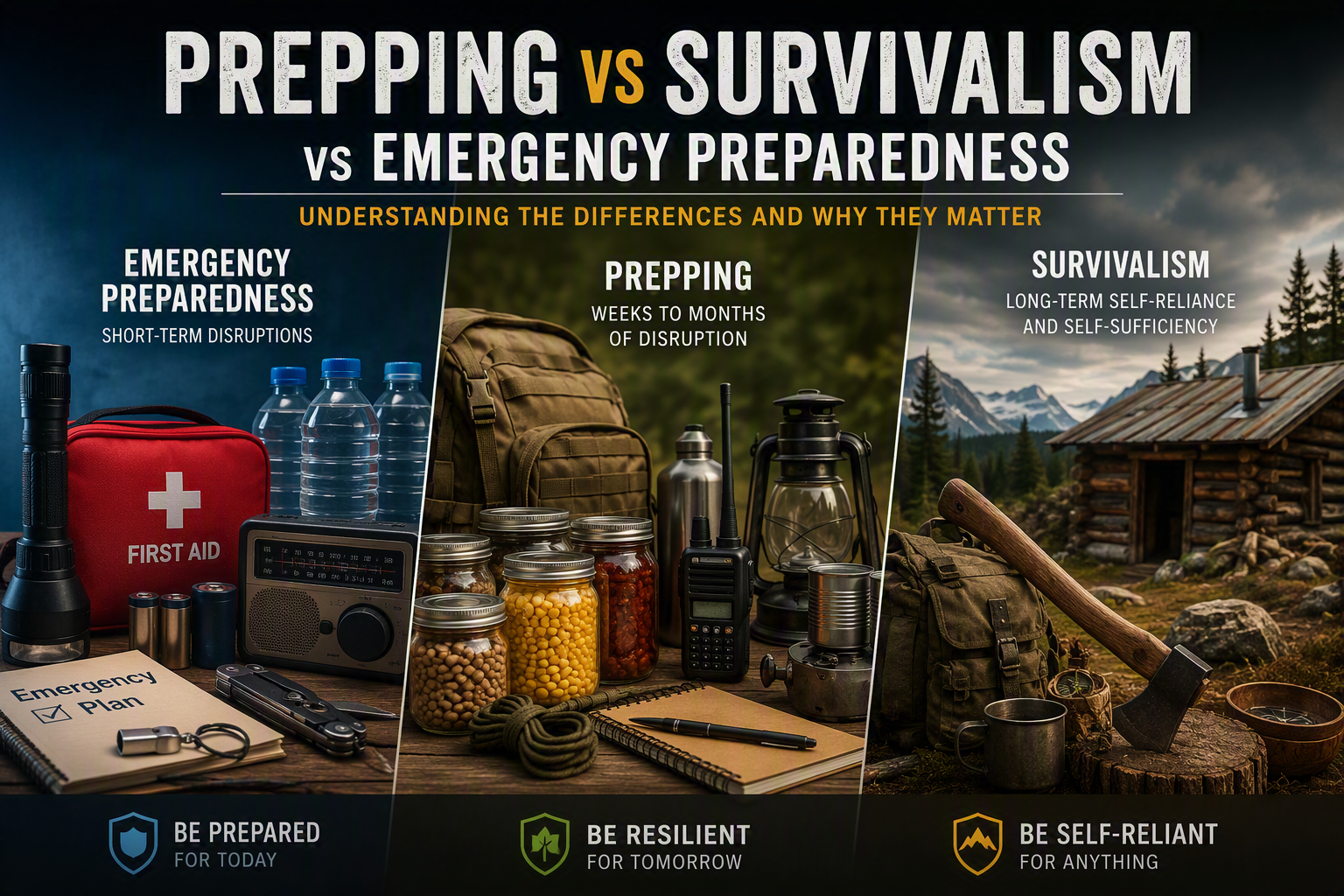
At one end of the spectrum is emergency preparedness, a practical and widely accepted approach that focuses on short-term disruptions. At the other is survivalism, which aims for self-sufficiency during prolonged crises. Nestled somewhere in the middle is prepping, a lifestyle that combines practical preparedness with longer-term resilience.
Emergency Preparedness: Ready for Everyday Disruptions
Emergency preparedness is something almost everyone can relate to, whether they realise it or not. It is centred around the idea that unexpected events happen and that having a plan can reduce stress, inconvenience, and risk when they do.
Think of the types of incidents most people are likely to experience during their lifetime: severe weather, flooding, power cuts, transport disruption, or temporary shortages in essential supplies. These events can be disruptive, but they are usually short-lived. Emergency preparedness is about having enough resources and planning in place to safely bridge the gap until normal services return.
A household that keeps torches for power outages, maintains a basic first aid kit, and stores a few days' worth of food and water is already practising emergency preparedness. The underlying assumption is that help is available and that society continues to function. The challenge is simply getting through a temporary interruption with minimal impact.
For this reason, emergency preparedness is often promoted by governments, local authorities, and emergency services. It is less about self-reliance and more about resilience during short-term emergencies.
Prepping: Building Layers of Resilience
Prepping begins where emergency preparedness leaves off.
Rather than focusing exclusively on events that might last a few hours or days, preppers consider what would happen if disruptions extended into weeks or months. Their concern is not necessarily catastrophic collapse but the growing recognition that modern systems are interconnected and sometimes fragile.
Recent years have provided plenty of examples. Supply chain issues, rising energy costs, fuel shortages, cyber security concerns, and extreme weather events have all demonstrated how quickly everyday conveniences can become unavailable.
As a result, prepping tends to focus on creating buffers between households and the systems they depend upon. This might mean maintaining larger food reserves, investing in alternative cooking methods, establishing backup power solutions, or learning practical skills that reduce reliance on external services.
The popular image of the prepper is often shaped by television programmes featuring underground bunkers and years of stored supplies. In reality, most preppers are far less dramatic. Many simply view preparedness as another form of insurance. Just as people insure their homes against events they hope will never happen, preppers invest time and resources to improve their ability to cope with uncertainty.
For many, prepping is not driven by fear of disaster but by a desire for greater independence and peace of mind.
Survivalism: Preparing for Extreme Scenarios
Survivalism occupies the far end of the preparedness spectrum and is often the most misunderstood.
Where emergency preparedness assumes services will be restored and prepping assumes disruptions may be prolonged, survivalism asks a much more fundamental question: What if there were no support systems at all?
The focus shifts from coping with disruption to maintaining independence in the face of major societal or environmental challenges. Survivalists often place a strong emphasis on practical skills, from wilderness navigation and shelter building to food production, water sourcing, and off-grid living.
Because of this focus on self-sufficiency, survivalism is frequently associated with remote locations, homesteading, and a deep understanding of traditional skills. Equipment remains important, but survivalists often prioritise knowledge and capability over stockpiles alone. After all, supplies eventually run out, while skills can be applied indefinitely.
This is perhaps the biggest distinction between survivalism and other forms of preparedness. The emphasis is not merely on storing resources but on developing the ability to sustain yourself when resources are scarce or unavailable.
More Similar Than Different
Although these labels are useful, the boundaries between them are often blurred.
Someone who buys a camping stove and stores extra food after experiencing a prolonged power outage may begin with emergency preparedness and gradually move into prepping. Likewise, a prepper who develops gardening skills, learns bushcraft, or experiments with off-grid living may adopt aspects of survivalism without ever identifying as a survivalist.
In many cases, preparedness evolves naturally over time. People experience challenges, identify weaknesses in their plans, and make improvements. What starts as a simple emergency kit can eventually grow into a broader focus on resilience and self-reliance.
Rather than viewing emergency preparedness, prepping, and survivalism as separate categories, it can be more helpful to see them as stages along a continuum. Each represents a different level of preparedness, with increasing emphasis on independence and long-term resilience.
So Which One Are You?
For most people, emergency preparedness provides the best place to start. Having enough food, water, lighting, medical supplies, and backup power to manage a few days without assistance will address the majority of realistic risks faced by households in the UK.
From there, some people choose to build additional resilience by adopting elements of prepping. A smaller number become interested in the self-sufficient lifestyle and advanced skills often associated with survivalism.
There is no right or wrong approach. Preparedness is not a competition, nor does it require expensive equipment or dramatic lifestyle changes. The most effective preparedness measures are often the simplest: understanding your risks, planning ahead, and taking gradual steps to reduce your vulnerability.
Final Thoughts
The differences between emergency preparedness, prepping, and survivalism are ultimately differences of scale and mindset.
Emergency preparedness focuses on short-term emergencies and getting through temporary disruptions safely. Prepping expands that thinking to cover longer-term challenges and builds additional layers of resilience. Survivalism takes the concept further still, aiming for self-sufficiency when conventional support systems may no longer be available.
What unites all three is a simple principle: preparation creates options. Whether you're storing a few days of supplies, building a household backup plan, or learning off-grid skills, the goal is the same. It's not about expecting the worst. It's about being ready for the unexpected and having the confidence to face whatever challenges come your way.