
17 September 2026
SecurityThe Five Ds of Perimeter Security: Building a Layered Protection Strategy
Discover the Five Ds of Perimeter Security: Deter, Detect, Deny, Delay, and Defend. Learn how to create a layered security strategy for your home, retreat, or preparedness location, including practical low-cost measures that work even on a limited budget.
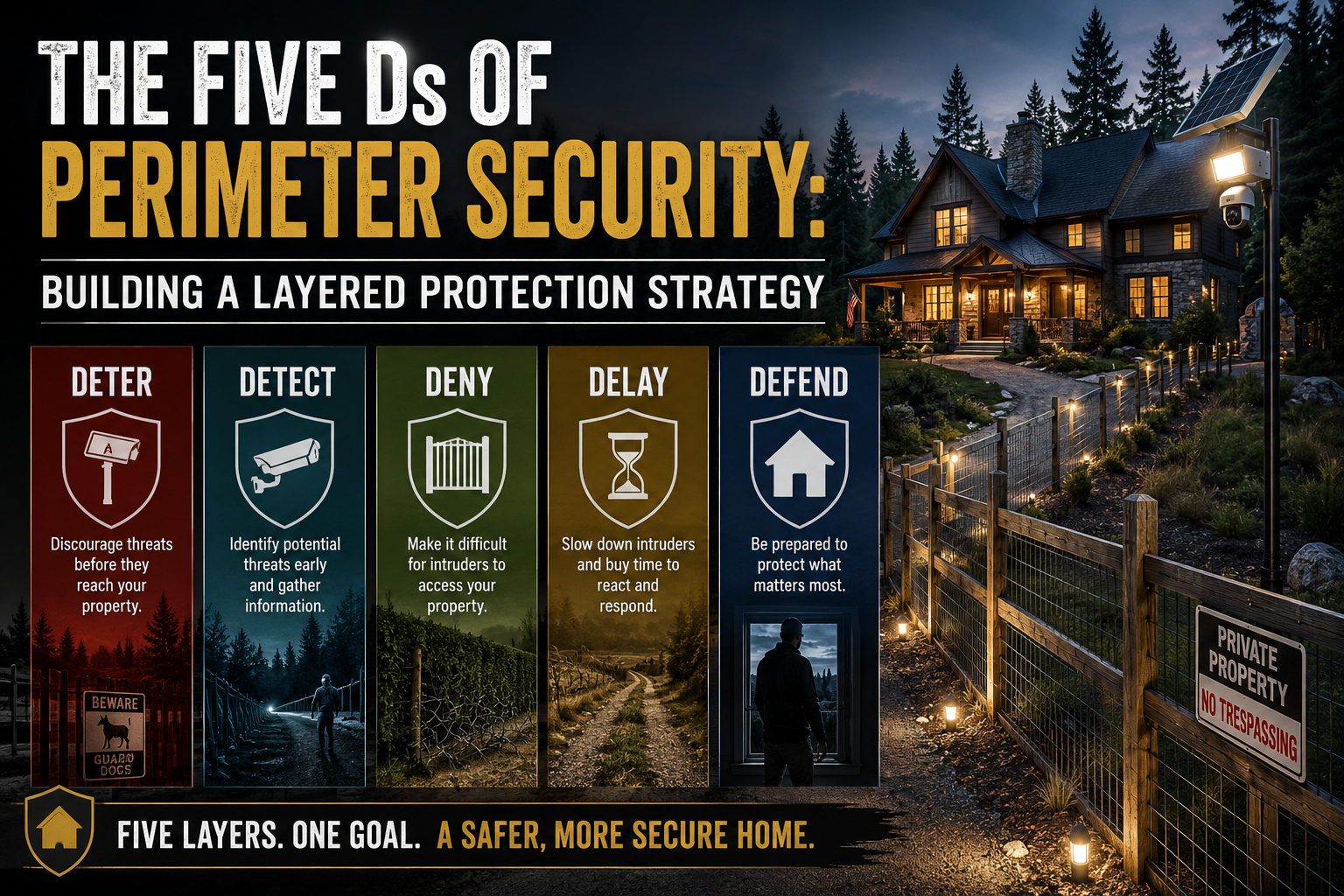
The Five Ds of Perimeter Security: A Practical Guide to Layered Security
When people think about securing their property, they often focus on a single solution. They install a stronger lock, put up a camera, or perhaps fit a security light and consider the job done.
Unfortunately, security doesn't work that way.
No single measure is perfect. Locks can be bypassed. Cameras can be avoided. Fences can be climbed. Real security comes from layers. Each layer increases the effort, risk, and time required for someone to gain access, while giving you more opportunities to identify and respond to a potential threat.
This concept is commonly known as the Five Ds of Perimeter Security: Deter, Detect, Deny, Delay, and Defend. Whether you're protecting a suburban home, a rural smallholding, a preparedness retreat, or even a flat in a town centre, these principles provide a simple framework for building an effective security strategy.
Think of it as an onion. Every layer serves a purpose, and together they create a far stronger defence than any individual measure could achieve on its own.
Deter: Make Your Property an Unattractive Target
The first objective is straightforward. Convince unwanted visitors to go somewhere else.
Most criminals and opportunistic intruders are not looking for a challenge. They are looking for an easy opportunity. If your property appears difficult to access, well-maintained, and actively monitored, many people will decide the risk simply isn't worth it.
Deterrence begins with the basics. A secure fence, well-maintained gates, and the absence of obvious weaknesses immediately suggest that the owner pays attention to security. Regular maintenance matters more than many people realise. A broken fence panel or damaged gate can unintentionally advertise a weak point.
Security lighting is another highly effective deterrent. Criminals generally prefer darkness and concealment. A well-lit property removes much of that advantage.
Visible CCTV cameras can also be valuable. While some people argue that cameras draw attention to valuable possessions, their primary purpose is to make someone think twice before crossing the boundary. Signage indicating CCTV coverage, alarm systems, or even the presence of dogs can further strengthen this psychological barrier.
For larger properties, occasional and unpredictable foot patrols can provide another layer of deterrence. Someone observing your home from a distance will quickly realise that people are present and moving around, making the property a less attractive target.
The aim is not to look intimidating. It is to look like more effort than the next property down the road.
Detect: Know When Something Is Happening
Deterrence will stop many threats, but not all of them.
Some individuals will ignore signs, cameras, fences, and lighting. That's why the second layer is detection.
Detection provides early warning. The sooner you know something is happening, the more time you have to make decisions and take appropriate action.
CCTV systems remain one of the most effective tools available. Visible cameras act as deterrents, while concealed cameras can continue monitoring if someone attempts to interfere with the obvious ones. In some situations, a hidden camera overlooking a visible camera can provide valuable additional evidence.
Trail cameras are another useful option, particularly for rural properties. Positioned along access routes, woodland edges, or less-frequented perimeter locations, they can reveal patterns of activity and help identify whether someone has been scouting an area.
Driveway alarms have improved tremendously in recent years. Affordable battery-operated models can detect movement and instantly alert you inside the property. Better still, many continue to function even during power outages.
Not every detection method needs to involve technology. Simple indicators can provide valuable information. A discreet marker on a gate, a carefully positioned object near an entrance point, or another subtle reference point can reveal that an area has been accessed since it was last checked.
Even something as simple as a gravel driveway contributes to detection. Walking quietly across gravel is remarkably difficult, especially at night. Sometimes the simplest solutions prove surprisingly effective.
The purpose of detection is simple: you cannot respond to a threat you haven't noticed.
Deny: Prevent Access Wherever Possible
Once someone reaches your perimeter, the next objective is preventing them from going any further.
This is where physical security becomes critical.
Strong locks, quality gates, reinforced doors, and secure hinges all play their role. However, security is only as strong as its weakest point. An expensive padlock means very little if the gate can simply be lifted off its hinges.
Regular inspections should form part of your routine. Look for anything that might assist access. Trees near fences, stacked materials, sheds positioned against walls, and even wheelie bins can become helpful climbing aids.
Natural barriers are another excellent option. Dense thorny planting such as hawthorn, blackthorn, pyracantha, or holly creates both a visual and physical obstacle. These plants have protected boundaries for centuries and remain just as effective today.
The goal is not necessarily to make access impossible. Instead, it is about making every route more difficult, less appealing, and less convenient.
Delay: Buy Yourself Time
Even well-designed security systems can sometimes be breached.
That is where the fourth D becomes important.
Delay measures are designed to slow progress after someone has gained access. Every second spent negotiating obstacles is another second available for detection, communication, or response.
Additional gates, layered fencing, strategic landscaping, dense hedges, and controlled pathways all contribute to delay. When movement becomes slower and more complicated, an intruder becomes more vulnerable to discovery.
Delaying measures do not need to be elaborate. Areas of rough terrain, decorative planters, dense vegetation, and carefully designed garden layouts can all force slower movement. When darkness, stress, and uncertainty are added into the equation, these seemingly minor obstacles become surprisingly effective.
The purpose of delay is not necessarily to stop someone outright. It is to create time.
- Time for alarms to be heard.
- Time for cameras to capture footage.
- Time for police to be notified.
- Time for occupants to move to safety.
In any security situation, time is one of the most valuable resources available.
Defend: Protect What Matters Most
The final layer is defence.
This is the innermost ring of the security model and represents the point where every other layer has failed to stop or divert the threat.
For most homeowners, defence begins at the entrance to the house itself. Secure doors, reinforced frames, quality locks, and a clear emergency plan provide the final barrier between a threat and the occupants.
In normal circumstances, defence should focus on keeping people safe while contacting emergency services and allowing the authorities to handle the situation. The earlier layers exist to ensure that if an incident occurs, it does not come as a surprise.
A successful defence layer relies heavily on everything that came before it. By the time someone reaches this point, they should have already been deterred, detected, denied easy access, and delayed during their approach.
Implementing the Five Ds on a Budget
One of the greatest myths surrounding security is that it requires expensive equipment and professional installation.
In reality, many of the most effective measures are surprisingly affordable.
Low-Cost Deterrence
Good housekeeping costs almost nothing. Repairing damaged fences, securing gates, trimming overgrown vegetation, and keeping a property looking occupied can dramatically improve security.
Solar-powered security lights are inexpensive and easy to install. CCTV warning signs cost very little yet can influence decision-making. Even evidence of regular activity around a property can act as an effective deterrent.
Affordable Detection
A basic driveway alarm can often be purchased for less than the cost of a tank of fuel and provides valuable early warning.
Wildlife trail cameras have also become increasingly affordable and offer a practical solution for monitoring remote areas.
For those on an extremely tight budget, simple indicators can provide valuable information. A discreet marker placed on a gate or access point can reveal whether an area has been used since it was last checked.
Cost-Effective Denial
Many access-denial improvements are simple DIY projects.
Upgrading screws in hinges, reinforcing gate fixings, improving lock security, and removing climbing aids all cost very little yet significantly strengthen a property's perimeter.
Defensive planting is another excellent long-term investment. Once established, thorny hedges provide security year after year with minimal ongoing expense.
Budget-Friendly Delay Measures
Gravel remains one of the cheapest and most effective delay-and-detection tools available.
Additional garden gates, raised beds, decorative barriers, planters, and dense shrubs can all slow movement without making a property resemble a fortress.
The objective is not to spend a fortune. It is simply to add obstacles that consume time and increase the chances of detection.
Defensive Preparation Costs Nothing
Finally, the defence layer is largely about planning.
Ensure family members know what to do during an emergency. Keep torches in accessible locations. Maintain charged communication devices. Have important contact details readily available.
Good preparation often provides more security value than expensive equipment.
Layered Security Wins Every Time
The Five Ds of Perimeter Security are not about turning your home into a fortress. They are about creating layers that work together.
A fence may deter. A camera may detect. A lock may deny. A barrier may delay. A secure room and emergency plan may provide defence.
Individually, each measure has limitations. Combined, however, they become significantly more effective.
Whether you live on a rural retreat with acres of land or in a small city flat, the principles remain the same. Adapt them to your circumstances, build layers where you can, and remember that good security is rarely about one expensive solution.
It is about creating enough obstacles, warnings, and delays that a problem is identified and dealt with long before it reaches your front door.