
22 September 2026
WaterHow to Make Water Safe to Drink in a SHTF Situation
Learn how to find, filter, purify, and safely store drinking water during emergencies and SHTF situations. Discover the strengths and limitations of popular water filters, UV purifiers, and treatment methods used by preppers.
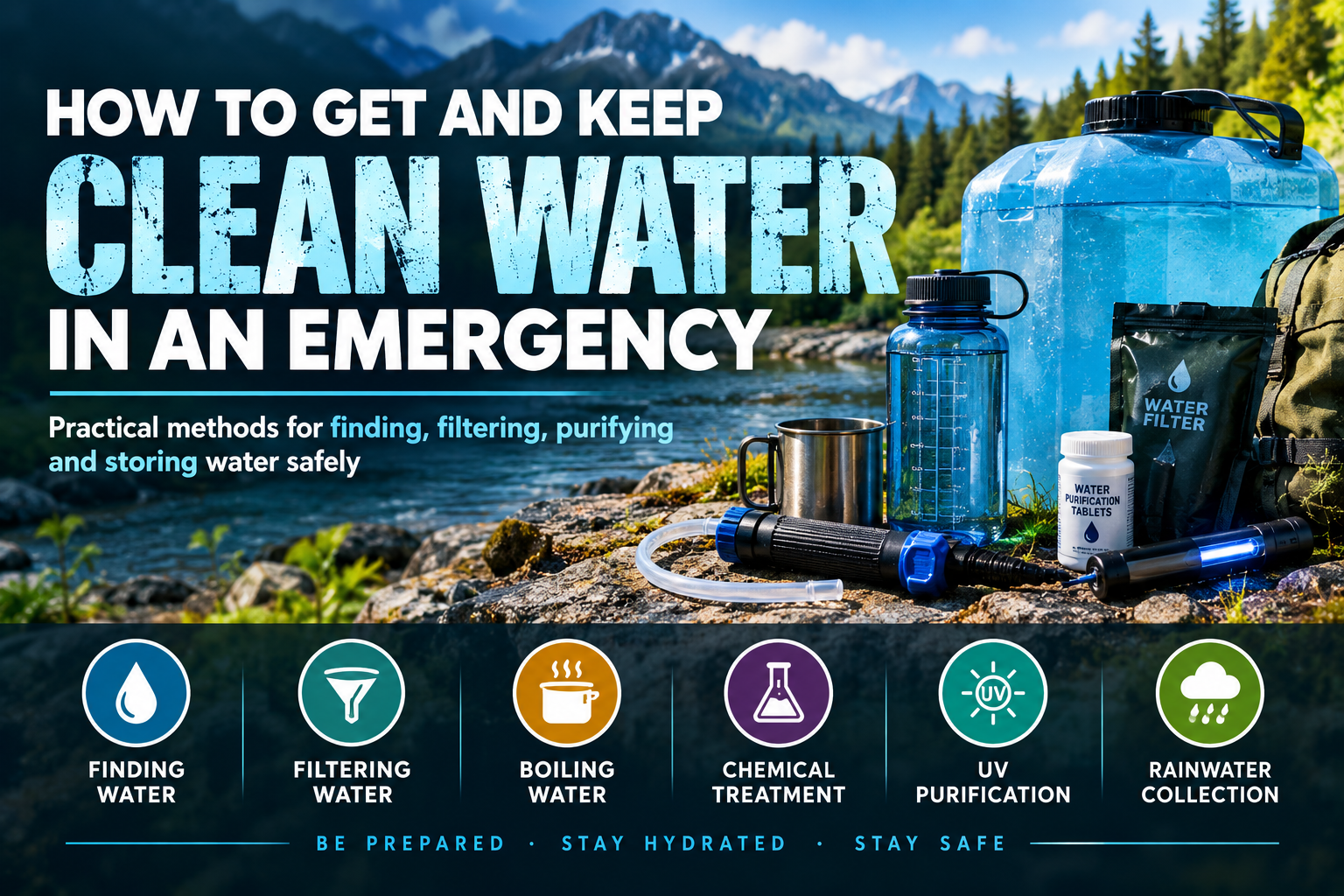
Water is one of the few resources that becomes immediately critical when normal life stops functioning.
Most people can survive for several weeks without food. Without clean water, however, dehydration and waterborne illness can become life-threatening in a surprisingly short time. In a major emergency, whether caused by severe weather, infrastructure failure, civil unrest, or a prolonged grid-down scenario, your ability to access safe drinking water may become more important than any piece of equipment sitting in your kit.
Finding water is often easier than people expect.
Finding water that is safe to drink is an entirely different challenge.
Streams, lakes, ponds, rainwater collection barrels, and even wells can all become contaminated. Some dangers are obvious. Many are not. Water that appears crystal clear may still contain harmful bacteria, viruses, parasites, agricultural runoff, or industrial pollutants.
When systems fail, assuming water is safe because it looks clean is a gamble few people can afford to take.
Start with the Best Source Available
The first step in water treatment begins long before you light a fire or remove a filter from its pouch.
Choose the cleanest source you can find.
Rainwater collected from a clean surface is often a better option than stagnant pond water. Fast-flowing streams are generally preferable to standing water. Natural springs can provide excellent water sources, although they should still be treated whenever possible.
Avoid water with chemical odours, oily sheens, unusual colours, or obvious signs of contamination. Likewise, be cautious around water sources near industrial estates, roads, agricultural land, flood zones, or mining operations.
The cleaner the source water, the more effective your treatment process is likely to be.
Water Filtration
Before purifying water, it is usually best to filter it.
Filtration removes physical debris such as dirt, sediment, insects, and organic matter. Depending on the filter, it can also remove many microorganisms that cause disease.
If the water is particularly muddy, allow it to settle first. Once the heavier sediment has dropped to the bottom, carefully pour the clearer water through a cloth, coffee filter, or bandana before beginning further treatment.
This simple step can significantly improve filtration performance and extend the life of your equipment.
For many people, LifeStraw is their first introduction to emergency water filtration.
Its lightweight straw design allows users to drink directly from streams, ponds, and other water sources without pumps, batteries, or complicated setup procedures. Small enough to fit inside a pocket, LifeStraw filters make excellent additions to bug-out bags and vehicle emergency kits.
Their limitation is volume. They are designed primarily for individual use rather than processing large quantities of water for cooking or family needs.
The Sawyer Mini and Sawyer Squeeze have become almost legendary within the preparedness community.
Compact, reliable, and highly versatile, they can be attached to water pouches, standard bottles, hydration bladders, or gravity-fed systems. Many experienced preppers carry one because it offers an excellent balance between weight, cost, durability, and filtration capacity.
If you only intend to own one portable survival filter, a Sawyer product is often near the top of the recommendation list.
The Katadyn BeFree is particularly popular among hikers, backpackers, and those who prioritise speed and convenience.
The soft collapsible bottle design makes it easy to carry, while the high flow rate allows users to produce drinking water quickly. Many outdoor enthusiasts prefer it because it feels more like drinking from a normal water bottle than using a traditional survival filter.
Grayl purifier bottles occupy a unique position in the market.
Rather than filtering water through a squeeze or gravity system, users press the water through the purification cartridge using a motion similar to a French press. The process is simple, intuitive, and fast.
Many travellers and preparedness enthusiasts appreciate Grayl products because they are designed to address a broader range of contaminants than many traditional backpacking filters.
When reliability and ruggedness are priorities, many outdoor professionals turn to MSR.
Their pump-style filters allow water to be processed rapidly and can handle more demanding environments than many ultralight alternatives. While heavier than squeeze filters, they are often favoured for expeditions, remote travel, and situations where durability matters more than carrying the lightest possible kit.
For long-term home preparedness, gravity-fed countertop systems can be invaluable.
Berkey and British Berkefeld are among the best-known names in this category. Their systems use gravity rather than electricity to process significant quantities of water, making them particularly useful during extended power outages.
These systems are far too large for evacuation purposes, but for sheltering in place they can form the backbone of a household water strategy.
Understanding Filter Limitations
No filter is perfect.
Most portable survival filters are highly effective against bacteria, protozoa, and parasites. Many are less effective against viruses. Others may improve taste but do little to address chemical contamination.
Before purchasing any filtration system, ensure you understand exactly what it has been tested and certified to remove.
Your life may one day depend on that knowledge.
Boiling: The Gold Standard
If fuel is available, boiling remains one of the most reliable methods of making water microbiologically safe to drink.
It is simple.
It is proven.
It requires very little specialised equipment.
Bringing water to a rolling boil destroys harmful bacteria, viruses, and parasites that could otherwise cause serious illness. After treatment, allow the water to cool and store it in a clean, covered container.
The biggest disadvantage is fuel consumption.
During a prolonged emergency, firewood, gas, or other fuel supplies can quickly become valuable resources, making alternative treatment methods attractive.
Chemical Water Treatment
Chemical disinfection is popular because it is lightweight, inexpensive, and easy to store.
Water purification tablets (like Oasis Water Purification Tablets 33mg - https://link.amazon/B0cjIhUMG) containing chlorine dioxide are among the most common options. Properly stored tablets can remain usable for years, making them excellent additions to bug-out bags and emergency kits.
In certain situations, plain unscented household bleach can also be used for emergency water treatment.
Accuracy matters.
Too little disinfectant may fail to neutralise pathogens. Too much can create other health concerns. Always follow the manufacturer's instructions or recognised emergency water-treatment guidelines.
UV Water Purification
Modern technology provides another highly effective treatment option.
Portable UV purification devices use ultraviolet light to disrupt the DNA of microorganisms, preventing them from reproducing and causing illness. When used correctly with relatively clear water, UV treatment can be extremely fast and effective.
The most recognised name in this category is SteriPen - https://link.amazon/B00eFkml3.
SteriPen devices have been trusted by travellers, hikers, aid workers, and preparedness enthusiasts for years. The process is straightforward. The user places the UV lamp into a container of water and stirs while the ultraviolet light treats the contents. Within a short period, the water can be ready for consumption.
Another notable option is CrazyCap.
Rather than using a handheld purifier, CrazyCap incorporates UV-C technology into a water bottle cap. While originally designed for travel and everyday use, it can serve as an additional layer of protection for stored drinking water in emergency situations.
Several other manufacturers produce portable UV-C purification wands and rechargeable treatment devices, but SteriPen remains the benchmark against which most are compared.
The advantages are clear.
Treatment is rapid. No chemical taste is introduced. There are no filter cartridges to replace during the purification process.
There are, however, limitations.
UV treatment works best on clear water. Muddy water should always be filtered beforehand. More importantly, UV devices rely on batteries, charging systems, solar panels, or power banks. Once the power runs out, so does your ability to use them.
For this reason, most experienced preppers view UV purification as one layer within a larger water plan rather than a complete solution on its own.
A practical setup might consist of:
- Sawyer Squeeze or Katadyn BeFree for filtration.
- SteriPen for rapid purification.
- Water purification tablets as a lightweight backup.
- The ability to boil water if all else fails.
Redundancy matters.
Filters clog. Batteries die. Equipment breaks.
Options save lives.
Solar Disinfection
If conventional treatment methods are unavailable, sunlight may provide another option.
Solar disinfection, commonly called SODIS, involves placing water into clear plastic bottles and exposing them to direct sunlight for extended periods. The combination of UV radiation and heat can reduce many biological contaminants.
It requires no specialised equipment.
It also requires patience.
Most preparedness-minded individuals view SODIS as a last-resort technique rather than a primary treatment method, but understanding how it works costs nothing and may prove useful in difficult circumstances.
Don't Forget Chemical Contamination
Many survival discussions focus entirely on bacteria and parasites.
That is a mistake.
Agricultural chemicals, petroleum products, industrial pollutants, heavy metals, and other contaminants may not be removed by many of the filtration methods commonly carried by preppers.
Activated carbon can help reduce some chemicals and improve taste, but no portable survival filter should be viewed as a cure-all.
Choosing the right water source remains your first and best line of defence.
Storage Is Just as Important as Treatment
Treating water is only half the battle.
Once purified, water must remain protected.
Use clean food-grade containers whenever possible. Keep lids securely fastened. Store water away from direct sunlight, fuels, chemicals, and potential sources of contamination.
Avoid dipping dirty hands, cups, or utensils into treated water.
Even well-purified water can become unsafe again if stored carelessly.
Build Layers into Your Water Plan
Experienced preppers rarely rely on a single solution.
Instead, they build redundancy into their systems.
A sensible setup might include several weeks of stored drinking water, a gravity-fed household filter, a portable Sawyer or Katadyn filter, purification tablets, a SteriPen, and the ability to boil water.
Each method covers weaknesses in another.
That is what good preparedness looks like.
Because when the taps stop flowing and the infrastructure you depend upon begins to fail, clean water stops being a convenience and becomes a necessity. Those who understand how to find it, filter it, purify it, and store it safely will be far better placed to weather whatever challenges lie ahead.
Artical contains affiliate links.