
9 October 2026
CommsOff-Grid & Emergency Communication Options for SHTF in the UK: A Prepper's Guide
Learn how to stay connected when the grid goes down. Discover the best off-grid and emergency communication options for UK preppers, including radios, walkie-talkies, CB, ham radio and satellite devices.
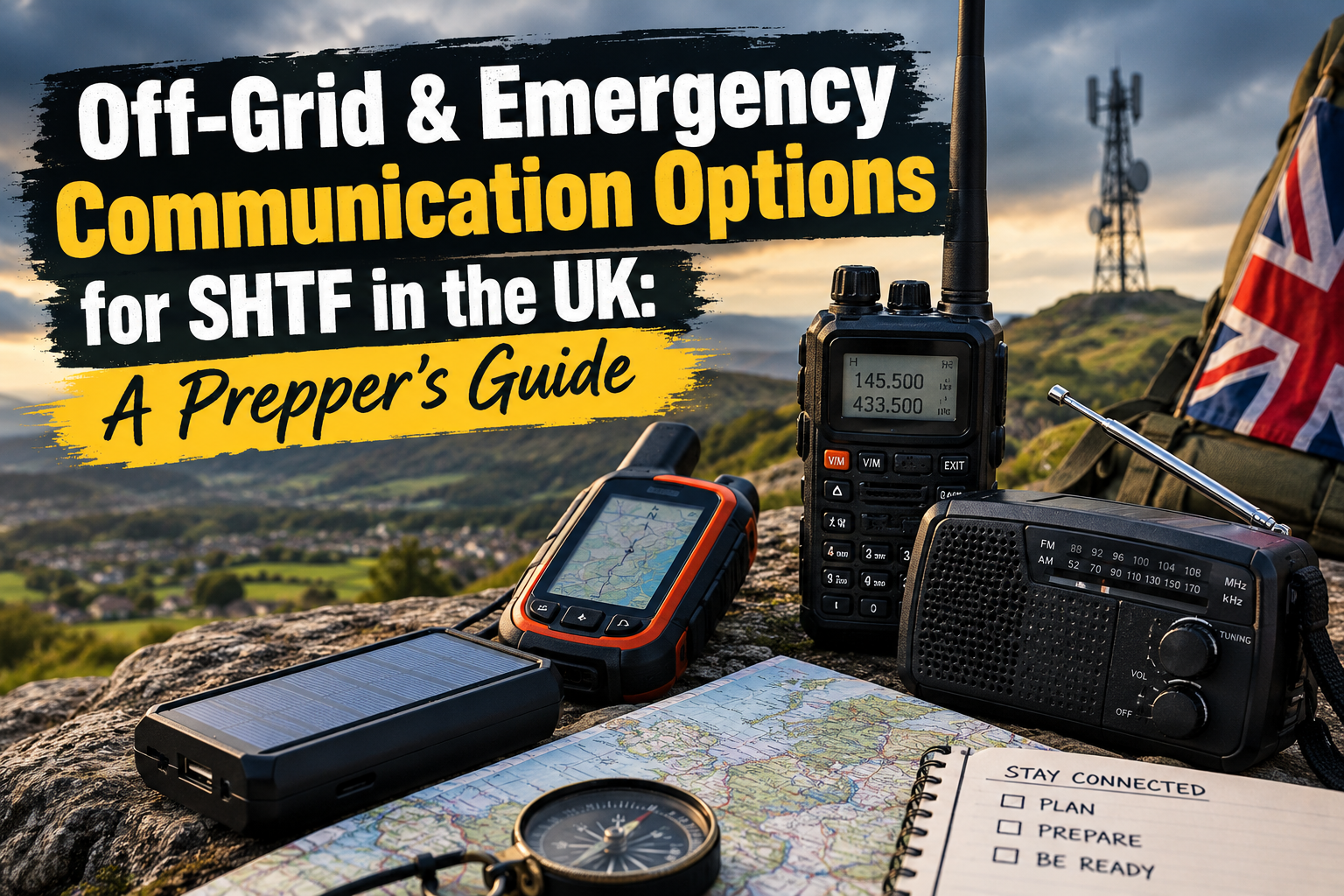
When the power goes out, mobile networks become overloaded, or severe weather cuts communities off, communication quickly becomes one of the most valuable resources you have. Food, water and shelter are essential, but the ability to receive information and stay in contact with family can be just as important.
Most people assume their mobile phone will always work. In reality, modern communication systems rely on a complex network of power supplies, data centres, mobile masts and internet connections. If any part of that chain fails, your smartphone may become little more than an expensive camera.
For UK preppers, having a simple and realistic emergency communications plan can make a significant difference during a major disruption. The good news is that there are several options available, ranging from inexpensive radios to more advanced off-grid solutions.
Communication should form part of your wider household preparedness strategy, alongside food, water, warmth and emergency supplies. If you're building your preparations from scratch, start with your UK emergency kit and make sure communications are included in your plans.
Why Communications Matter During a Crisis
Information reduces uncertainty.
If you know what is happening, where hazards exist, and whether help is likely to arrive, you can make informed decisions. Without reliable information, rumours spread rapidly and poor decisions often follow.
Communication is also about coordination. Families may become separated. Neighbours may need assistance. Local communities may need to share resources and information.
Planning ahead now is far easier than trying to establish communications during a crisis.
This is particularly important during a prolonged power cut. Your household may need to coordinate supplies, check on vulnerable relatives and monitor official updates. Our guide to preparing for a power cut in the UK explores the wider preparations that can help you cope when essential services are disrupted.
The Limits of Mobile Phones
Mobile networks are remarkably resilient, but they are not invincible.
During local emergencies, large public events, or widespread power cuts, cellular networks can become congested. Calls may fail while text messages take considerable time to arrive. In larger disasters, damage to infrastructure can cause outages that last for extended periods.
That does not mean mobile phones are useless. Far from it. They should remain part of your communications strategy. The key is ensuring they are not your only strategy.
Keep power banks fully charged. Consider having a solar charger or portable power station. Download local maps for offline use and save important phone numbers on paper.
You should also familiarise yourself with the emergency alert settings on your phone and understand that alerts and mobile services may not be available in every situation.
Technology is wonderful until the battery reaches 0%.
For a more complete approach to household resilience, combine communications planning with the advice in our UK emergency kit guide.
FM, AM and DAB Radios
One of the simplest and most effective preparedness tools is a battery-powered radio.
The ability to receive official information without relying on mobile networks or an internet connection can be invaluable. Local and national broadcasters may provide updates on weather conditions, infrastructure failures, evacuation routes and public safety advice.
A small radio takes up very little space but offers significant value.
Consider:
-
Battery-powered radios.
-
Hand-crank emergency radios.
-
Solar-powered emergency radios.
-
Radios with integrated torches and USB charging capabilities.
Check which broadcast bands your chosen radio supports. AM and FM reception can be useful, while DAB provides access to digital stations where a suitable signal is available.
Keep spare batteries stored safely and test equipment regularly. If your radio uses rechargeable batteries, ensure you have a way to recharge it when the mains supply is unavailable.
A radio is most useful when it is part of a wider plan for coping without electricity. If you haven't already done so, read our guide to preparing for a UK power cut.
PMR446 Walkie-Talkies
For many UK households, PMR446 radios represent the best balance between cost, legality and practicality.
These licence-free walkie-talkies can be purchased relatively cheaply and allow communication between family members, neighbours or members of a preparedness group.
Their range is often exaggerated by manufacturers. While packaging may claim 10km or more, real-world performance is heavily affected by terrain, buildings, obstructions and antenna height. In urban areas, range may be considerably shorter than expected.
Even so, PMR446 radios can be extremely useful for:
-
Local neighbourhood coordination.
-
Family communication during power outages.
-
Community preparedness groups.
-
Keeping in contact while travelling on foot.
-
Coordinating activities around a home or temporary evacuation location.
They require no mobile network and can operate for long periods using suitable batteries.
Before relying on a pair of radios, test them between the locations where you expect to use them. Learn how to select channels, adjust the volume and lock the controls to prevent accidental changes.
Remember that licence-free does not mean private. Other users may be able to hear your transmissions, so avoid sharing sensitive personal information.
Simple. Reliable. Effective.
LoRa Mesh Radio: Meshtastic and MeshCore
One of the more interesting developments in off-grid communications is LoRa mesh radio. Using low-power radio technology, devices can exchange short text messages and relay them through other participating devices, potentially allowing messages to travel beyond the range of a single radio link. Two projects worth exploring are Meshtastic and MeshCore.
Meshtastic is an open-source system designed to create off-grid mesh networks for messaging and location sharing, typically using inexpensive LoRa-compatible devices paired with a smartphone. MeshCore is another mesh communications platform, offering a different approach to creating and managing networks of radio nodes. Both can be useful when mobile data and conventional internet access are unavailable, provided other compatible nodes are within reach.
For UK preppers, these systems offer an appealing middle ground between basic walkie-talkies and more advanced radio equipment. Devices are generally compact, consume relatively little power and can be useful for neighbourhood coordination, group activities or keeping in touch during an extended outage. However, coverage depends on terrain, buildings, antenna placement and the number and positioning of participating nodes. A mesh network is not automatically available everywhere, and messages may not get through if there are no suitable nodes to relay them.
Before buying equipment, check that it operates on the appropriate UK frequency and complies with current Ofcom requirements. Practise with your chosen system, build a local network where possible and remember that mesh messaging is not a substitute for emergency services or a guaranteed means of communication.
CB Radio
Citizens Band radio has experienced something of a revival among preparedness-minded people.
CB radios can be useful for communication between vehicles and fixed locations. Under favourable conditions, a suitable setup may achieve considerably greater range than a typical handheld walkie-talkie.
A vehicle-mounted CB setup can be particularly useful during evacuations or severe weather when normal communication channels become unreliable.
The downside is the larger equipment requirement and the need for suitable antennas. Performance depends on the equipment, antenna installation, terrain and local radio conditions.
Before investing, check the applicable UK regulations and equipment requirements. As with any radio system, practise using it before you depend on it.
For most households, CB is best considered an additional communications layer rather than a replacement for mobile phones or local handheld radios.
Amateur (Ham) Radio
If communication is a serious part of your preparedness strategy, amateur radio deserves consideration.
Amateur radio operators communicate over local, national and international distances using a wide range of frequencies and equipment. Depending on the equipment, propagation conditions and operating method, communications may remain possible even when commercial infrastructure is disrupted.
There is a learning curve involved. Equipment costs vary considerably, and a UK amateur radio licence is required before transmitting on amateur frequencies.
However, the benefits can be substantial. Licensed operators gain access to a community of experienced radio users, technical knowledge and communication capabilities beyond those offered by most licence-free consumer equipment.
Start by learning the basics, exploring local amateur radio clubs and understanding the licensing process. You do not need to purchase expensive equipment immediately.
The important principle is to build skills alongside equipment. A radio that you understand and can operate confidently is far more valuable than one that sits unused in a cupboard.
Satellite Communications
Satellite communications provide another option when terrestrial networks are unavailable.
Satellite messengers can allow users to send messages from remote locations, while some devices offer SOS functionality. Certain modern smartphones also support limited satellite-based emergency features, depending on the model, location and service availability.
The advantages are clear. Where compatible equipment has a suitable view of the sky and the satellite service is operational, communication may still be possible even when mobile coverage is absent.
However, satellite equipment has limitations. Purchase costs, subscriptions, battery life, obstructions and service availability all matter. Trees, buildings and difficult terrain can interfere with access to satellites, while widespread emergencies may create additional pressures on services.
For most people, satellite communications are a supplementary option rather than a primary one.
If you regularly travel into remote areas, or have particular reasons to maintain contact when isolated, a satellite messenger may be worth considering.
Creating a Family Communications Plan
Buying equipment is only part of the solution.
A communications plan is arguably more important than the devices themselves. If everyone knows what to do when phones stop working, your household will be in a much stronger position.
Consider the following:
-
Meeting points: agree where family members should meet if communication fails.
-
Primary and secondary contact methods: decide how you will communicate if your preferred method is unavailable.
-
Scheduled check-in times: establish when family members should attempt contact.
-
Local family contacts: identify someone nearby who can help coordinate arrangements.
-
Out-of-area emergency contacts: choose a trusted contact who can relay messages between separated family members.
-
Agreed radio channels: establish which channels to use for family or group communications, where appropriate.
-
Emergency information: keep important phone numbers, addresses and instructions on paper.
Everyone in the household should know the plan.
Write it down. Print copies. Keep one at home, one in an emergency bag and another in your vehicle.
Make sure the plan works for children, older relatives and anyone who may need additional support. Avoid relying on a single family member to remember every detail.
Your communications plan should also fit into your wider decision-making process. For example, knowing when to remain at home and when to leave is easier if your household has already considered the options in our guide to bugging in versus bugging out in the UK.
Building a Communications Kit
A practical UK prepper communications kit does not need to be expensive. Start with the essentials and expand as your needs and budget allow.
Basic kit
-
Emergency FM, AM or DAB radio.
-
Spare batteries.
-
Fully charged power bank.
-
Compatible charging cables.
-
Printed emergency contact list.
-
Waterproof notebook.
-
Pencil.
-
Paper copy of your household communications plan.
Intermediate kit
Everything in the basic kit, plus:
-
Pair of PMR446 radios.
-
Spare or rechargeable radio batteries.
-
Suitable solar charger.
-
Vehicle charging adapters.
-
Local paper maps.
-
Written instructions for using your equipment.
Advanced kit
Everything above, with selected additional equipment such as:
-
CB radio setup.
-
Licensed amateur radio equipment.
-
Appropriate portable antenna.
-
Portable power station.
-
Satellite communicator.
-
Additional charging and power-management equipment.
You do not need every item on this list. The right setup depends on your budget, location, household needs and preparedness goals.
For instance, a family preparing for occasional winter power cuts may benefit more from a reliable emergency radio, power banks and a written plan than from investing immediately in advanced radio equipment.
Preparedness is about matching your resources to realistic risks.
Practice Before You Need It
Equipment stored in a cupboard for years is unlikely to help during an emergency.
Test radios regularly. Charge power banks. Replace batteries before they expire. Check that charging cables still work and that everyone knows where the equipment is stored.
Conduct occasional family communication exercises. Try a simple scenario in which mobile data is unavailable, then practise following your written plan.
Check whether your radios work at your agreed meeting points. Make sure everyone can operate them without assistance.
It is also worth reviewing your arrangements when circumstances change, such as when children start travelling independently or family members move home.
The best gear in the world is useless if nobody remembers how to use it when stress levels are high.
Final Thoughts
When people think about prepping, they often focus on food storage, generators and water supplies. Yet communication is one of the most overlooked aspects of preparedness.
A simple battery-powered radio may prove more valuable than an extra box of supplies. A pair of walkie-talkies could help coordinate with family when mobile networks fail. For those willing to invest time and training, amateur radio can provide remarkable capabilities when conventional systems are unavailable.
No single solution is perfect. The most resilient approach is to layer multiple methods together, creating redundancy that allows you to adapt as conditions change.
Start with a radio, a charged power bank, a printed contact list and a family plan. Build from there.
If you're developing your overall preparedness strategy, explore our guides to the UK emergency kit, power-cut preparation and bugging in versus bugging out.
Because in a genuine SHTF scenario, information is power. And the ability to communicate may be one of the most important tools you own.