22 September 2026
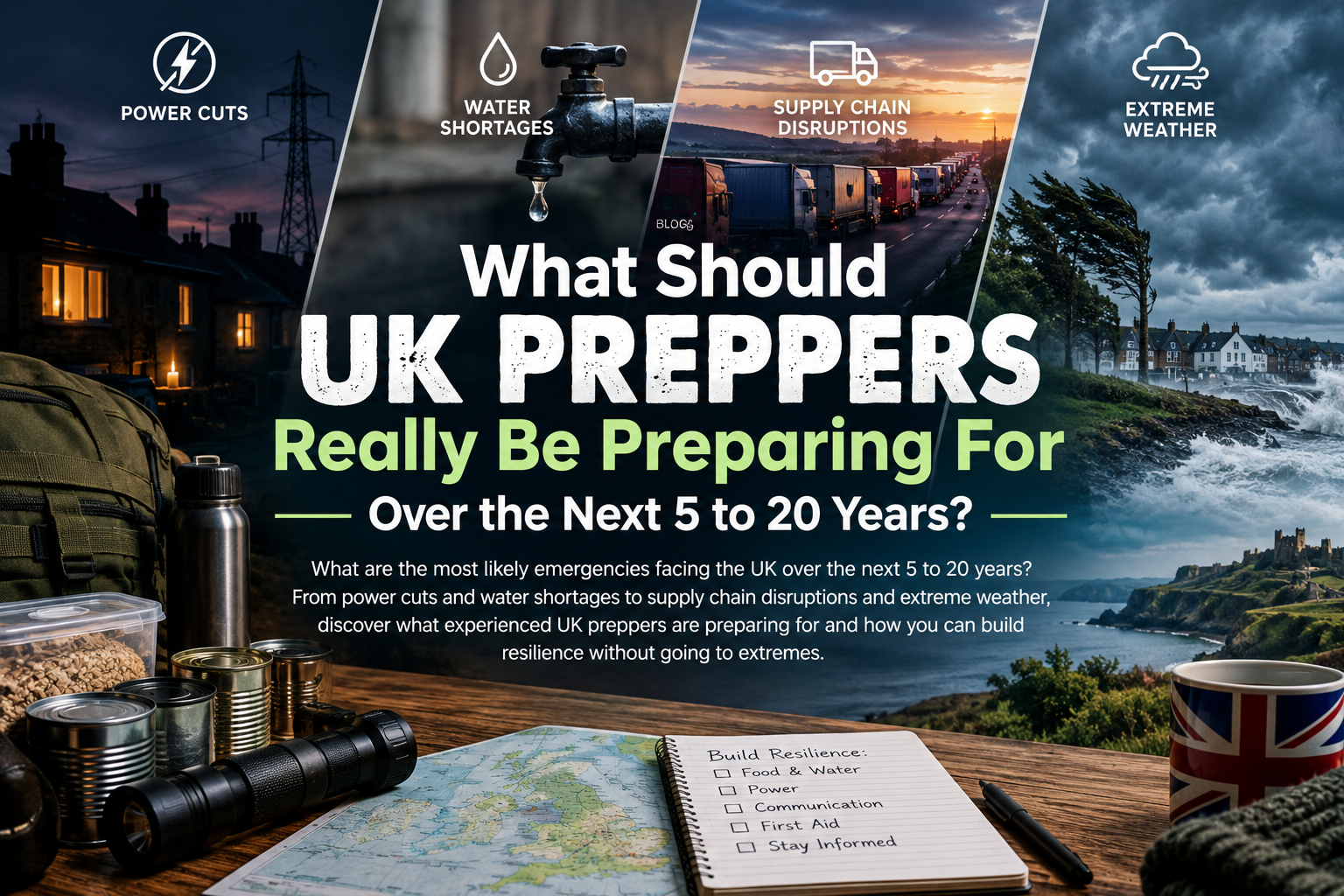
General PreppingWhat Should UK Preppers Really Be Preparing For Over the Next 5 to 20 Years?
What are the most likely emergencies facing the UK over the next 5 to 20 years? From power cuts and water shortages to supply chain disruptions and extreme weather, discover what experienced UK preppers are preparing for and how you can build resilience without going to extremes.
When most people first discover prepping, they quickly run into a problem: there is no obvious finish line.
You start by buying a torch and a few bottles of water. Then you read about power outages. Then supply chain disruptions. Then cyber attacks, droughts, flooding, economic instability, pandemics, and geopolitical tensions. Before long, it's easy to wonder whether preparedness is a sensible hobby or the beginning of an endless rabbit hole.
That question recently sparked a fascinating discussion among UK preppers, and a clear theme emerged. Most people are not preparing for the end of the world. They're preparing for the kind of disruptions that are increasingly appearing in everyday life.
Preparing for "Next Tuesday", Not Doomsday
The biggest takeaway was surprisingly simple.
Many experienced preppers are focused on what could happen next month rather than what might happen at the end of civilisation. A prolonged power cut. A contaminated water supply. Flooding. Supply shortages. Severe weather. Temporary disruption to transport, communications, or essential services.
These events aren't theoretical. The UK has already experienced many of them in recent years.
For most households, having enough supplies to comfortably manage three days to a month without relying on supermarkets or public services would put them far ahead of the majority of the population.
That doesn't require a bunker. It doesn't require a remote compound in the Highlands.
It simply requires a bit of planning.
The Risks That Concern UK Preppers Most
Across the discussion, several threats appeared repeatedly.
Power outages were high on the list. As homes become increasingly dependent on electricity for heating, cooking, communications, banking, and entertainment, even a relatively short outage can become disruptive.
Water shortages were another major concern. Several people pointed out that water supplies have already been interrupted in parts of the UK, often with little warning. Hotter summers and growing demand are making water security a more practical concern than many people realise.
Food supply disruptions also featured heavily. The lessons of Covid-19 remain fresh. Empty shelves, shortages of household essentials, and panic buying demonstrated how quickly modern supply chains can struggle when demand suddenly spikes.
Climate-related disruptions were frequently mentioned too. Flooding, storms, droughts, wildfires, and heatwaves all appear to be becoming more common discussion points. Even when these events do not directly affect a household, they can trigger knock-on effects through higher food prices, infrastructure problems, and disrupted transportation networks.
Some contributors also highlighted cyber attacks and infrastructure failures. For the average family, it hardly matters whether a power outage is caused by severe weather, equipment failure, or malicious activity. The practical consequences are largely the same.
Start With the Basics
A common mistake among new preppers is assuming they need specialist equipment immediately.
In reality, many of the most useful preparedness items are things people already own.
Camping gear appeared again and again as one of the most valuable forms of preparedness. Camping stoves allow cooking during power cuts. Sleeping bags help keep families warm if heating systems fail. LED lanterns provide reliable lighting. Power banks keep phones charged.
These are everyday items with multiple uses.
The same principle applies to food storage. Several contributors recommended building a pantry around products already used by the household rather than buying unfamiliar emergency rations.
If your family regularly eats pasta, rice, beans, tinned vegetables, tuna, soup, cereal, or UHT milk, simply keeping extra quantities on hand can create weeks of resilience without changing your lifestyle.
The key is rotation.
Use what you store and replace it as needed.
Water: The Often Overlooked Priority
If there was one area where experienced preppers seemed to consistently place greater importance than newcomers, it was water.
Food shortages are uncomfortable. A lack of clean water can become serious very quickly.
Many households can store a month's worth of food in surprisingly little space. Water is another story entirely.
Some preppers rely on bottled water reserves. Others use food-grade HDPE water containers, water butts, camping water carriers, and purification systems. Several mentioned combining stored water for drinking with rainwater collection for non-potable uses such as toilet flushing and garden irrigation.
For most households, simply having several days of drinking water available is a significant improvement over having none.
Skills Often Matter More Than Gear
One of the most thoughtful observations was that knowledge is a prep nobody can steal.
While supplies can be consumed, damaged, or lost, skills remain valuable throughout life.
First aid was frequently mentioned. Gardening appeared near the top of many recommendations. So did cooking from basic ingredients, home maintenance, food preservation, sewing, and practical DIY skills.
These abilities improve quality of life even when there is no emergency.
That is perhaps why they sit at the heart of modern preparedness.
The most resilient people are rarely those with the largest stockpiles. More often, they are the ones who can adapt when circumstances change.
The Importance of Community
The stereotype of prepping often involves isolation. A lone individual protecting their supplies from the outside world.
The reality discussed by many contributors was almost the opposite.
Strong community ties repeatedly emerged as one of the most effective forms of preparedness.
Neighbours can share information during service disruptions. Friends can provide assistance when roads are blocked or equipment fails. Local growers, allotment holders, and farmers often become valuable sources of support during periods of scarcity.
During Covid, many people discovered that community networks proved just as important as physical supplies.
Preparedness is not simply about what sits on your shelves. It is also about who is in your phone contacts.
Should You Move to the Countryside?
This question generated mixed opinions.
Some argued that rural living offers greater opportunities for gardening, keeping chickens, collecting rainwater, and developing self-sufficiency.
Others warned against romanticising country life.
Remote communities can experience longer power restoration times, weaker infrastructure, fewer local services, and greater distances to supermarkets and healthcare facilities. Several rural contributors noted that their areas were often among the last to have services restored following storms.
The consensus seemed to be that preparedness matters more than postcode.
A well-prepared household in a town is likely to fare better than an unprepared household on a picturesque rural smallholding.
A Practical Mindset for the Future
Perhaps the most sensible perspective offered in the discussion was that prepping should not become an obsession.
Nobody knows exactly what the next decade will bring.
There may be heatwaves, storms, water restrictions, cyber attacks, economic challenges, fuel shortages, or disruptions that nobody currently sees coming. The goal is not to predict every possible crisis. It is to increase your ability to cope with uncertainty.
A few extra weeks of food. Stored water. Alternative cooking methods. Emergency lighting. Basic medical supplies. Useful skills. Strong community connections.
These preparations help during a major emergency.
More importantly, they also help during ordinary life.
And that may be the best definition of preparedness there is: building a life that remains comfortable, adaptable, and resilient when things do not go according to plan.