11 September 2026
General PreppingPrepping Discreetly
How to Prep Discreetly in the UK Without Looking Like You've Gone Off the Deep End
How to Prep Discreetly in the UK Without Looking Like You've Gone Off the Deep End
For many people in the UK, preparedness comes with an unexpected challenge. It is not finding storage space or building supplies. It is avoiding the social stigma that can come with being labelled a "prepper".
While preparedness is often viewed as sensible in other parts of the world, many Britons still associate the term with underground bunkers, doomsday predictions and survivalist fantasies. As a result, people who simply want to be ready for everyday disruptions often wonder whether they can prepare quietly without attracting unwanted attention from family, friends or neighbours.
The good news is that most experienced UK preppers agree on one thing: discreet preparedness is not only possible, it is probably the most sensible approach.
The Difference Between Prepared and Paranoid
A recurring theme among UK preppers is that context matters.
Most people would not think twice about someone keeping extra tins in the cupboard, a few cases of bottled water in the garage, or a torch in the drawer. These are practical measures for dealing with common inconveniences such as power cuts, bad weather or temporary supply shortages.
The perception changes when preparedness appears excessive or disconnected from realistic risks. There is a significant difference between maintaining sensible contingency plans and building your life around highly unlikely disaster scenarios.
For many people, the key is focusing on ordinary disruptions rather than extraordinary ones.
Most Preparedness Looks Completely Normal
One of the reasons discreet prepping works so well is because much of it already overlaps with everyday life.
Maintaining an emergency fund, keeping a stocked pantry, owning spare batteries, storing medicines, buying essentials when they are on offer, and learning practical skills are all forms of preparedness. Most people simply do not describe them that way.
In reality, many households already engage in some level of preparedness without ever considering themselves preppers.
The most successful approach is to build resilience gradually through normal habits rather than dramatic stockpiling.
Stop Calling It "Prepping"
Language plays a surprisingly important role.
The word "prepper" carries a lot of baggage, particularly in the UK. It immediately brings to mind television documentaries about doomsday survivalists and internet conspiracy theories.
By contrast, saying you like to be prepared for power cuts, flooding, bad weather or temporary shortages sounds entirely reasonable.
The practical actions are identical, but the framing is very different.
Most people are far more receptive to discussions about emergency planning than conversations about societal collapse.
Buy in Bulk and Rotate Everything
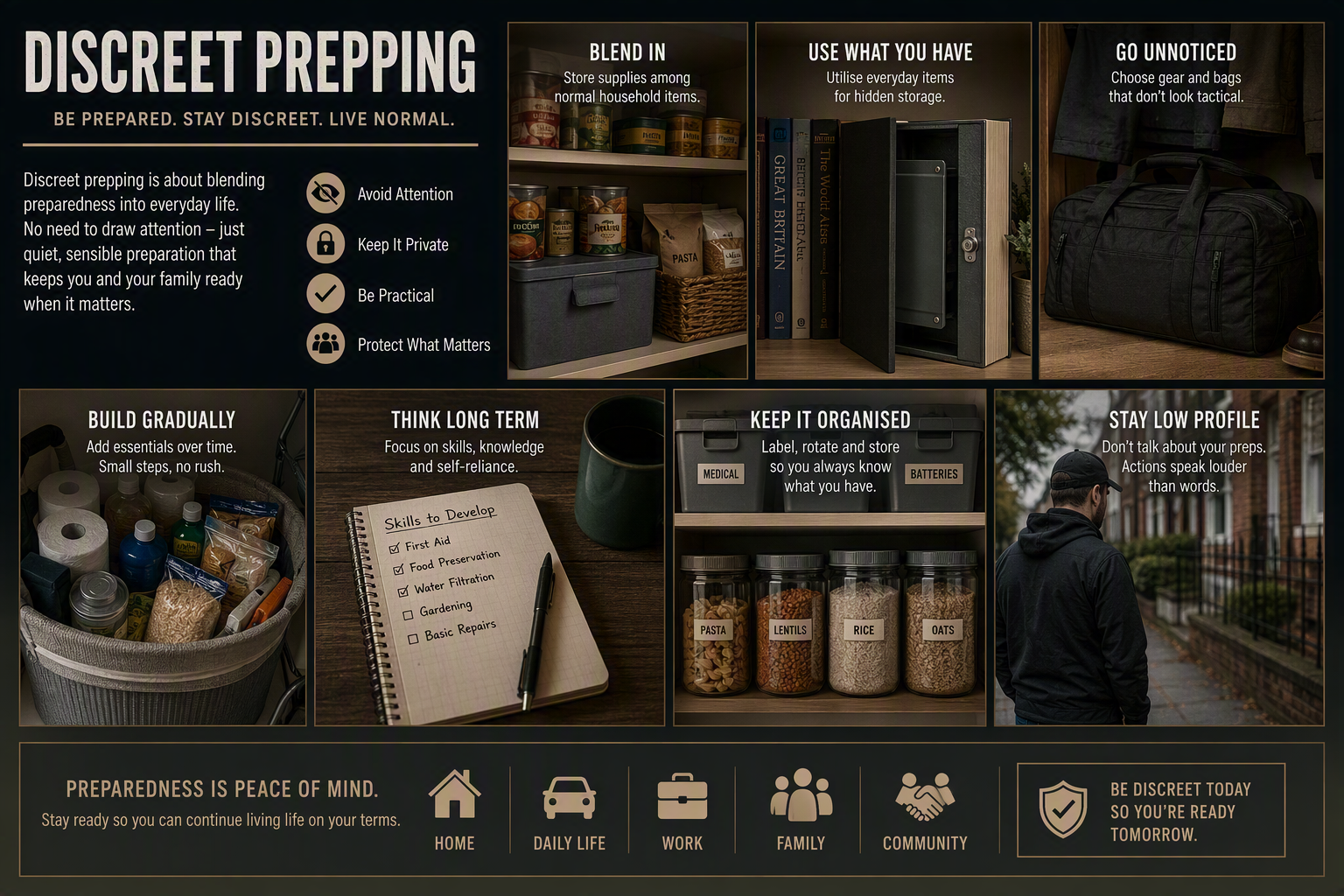
One of the simplest ways to build supplies discreetly is to buy more of the items you already use.
Instead of purchasing specialist survival food, many experienced preppers simply stock additional quantities of everyday products:
- Tinned foods
- Pasta and rice
- Toiletries
- Cleaning products
- Bottled water
- Household essentials
Bulk purchasing often saves money and naturally creates a reserve of supplies.
Because these items are already part of the household's normal routine, they never look unusual. A well-stocked pantry can easily be explained as smart budgeting rather than emergency planning.
The key is rotation. Items should be regularly used and replaced so nothing expires or goes to waste.
Store It Neatly and Out of Sight
Many people worry about what neighbours will think, but the reality is that most people never see what is stored inside your home.
Supplies kept in spare cupboards, garages, lofts, under-bed storage or shelving units are rarely visible to anyone outside the household.
Discreet preparedness is often nothing more complicated than good organisation.
The less visible your supplies are, the less likely they are to become a topic of conversation.
Focus on Skills Rather Than Stockpiles
One of the most valuable lessons from experienced preppers is that resilience is not just about storing things.
Skills are often more valuable than supplies.
Learning first aid, growing food, preserving produce, repairing household items, managing finances and improving physical fitness all contribute to preparedness.
Unlike stockpiles, these skills attract little attention and often improve quality of life regardless of whether an emergency ever occurs.
Many seasoned preppers view their health, knowledge and financial stability as their most important preparations.
COVID Changed Public Opinion
Attitudes towards preparedness have changed considerably since the COVID-19 pandemic.
For many people, the experience of empty supermarket shelves, supply chain disruption and sudden uncertainty challenged the assumption that services and supplies would always be available.
Brexit-related disruptions, fuel shortages, storms and extended power outages have reinforced that lesson in recent years.
As a result, keeping a modest supply of essential items no longer appears nearly as unusual as it once did. What was previously viewed as excessive is often now considered prudent.
Don't Advertise Your Supplies
Many preppers adopt a simple rule: preparedness does not need to be public knowledge.
There is often little benefit in broadcasting how much food, water or equipment you have stored.
Keeping preparations private avoids unnecessary judgement while also preserving security should a genuine emergency occur.
Preparedness is usually most effective when it remains an ordinary part of household management rather than a defining personality trait.
Community Matters More Than Most People Think
Interestingly, many experienced preppers place just as much value on relationships as they do on supplies.
Having trusted neighbours, strong local connections and a supportive community can be incredibly valuable during difficult times.
While discretion about personal supplies is sensible, building goodwill and maintaining positive relationships may be one of the most practical forms of preparedness available.
Resilient communities often weather disruptions far better than isolated individuals.
The Bottom Line
The reality is that discreet prepping in the UK is less about hiding supplies and more about approaching preparedness in a practical, balanced way.
Buy what you already use. Rotate it regularly. Build financial security. Learn useful skills. Prepare for realistic disruptions rather than fantasy scenarios.
Most importantly, remember that preparedness does not have to become an identity. It can simply be part of running a well-organised household.
The people who attract attention are rarely those quietly keeping extra food, water and emergency supplies. They are the ones who make preparedness the centre of every conversation.
For everyone else, being prepared is often so ordinary that nobody notices at all. In many ways, that is exactly how it should be.
Other articles you may find useful: